
Sale!
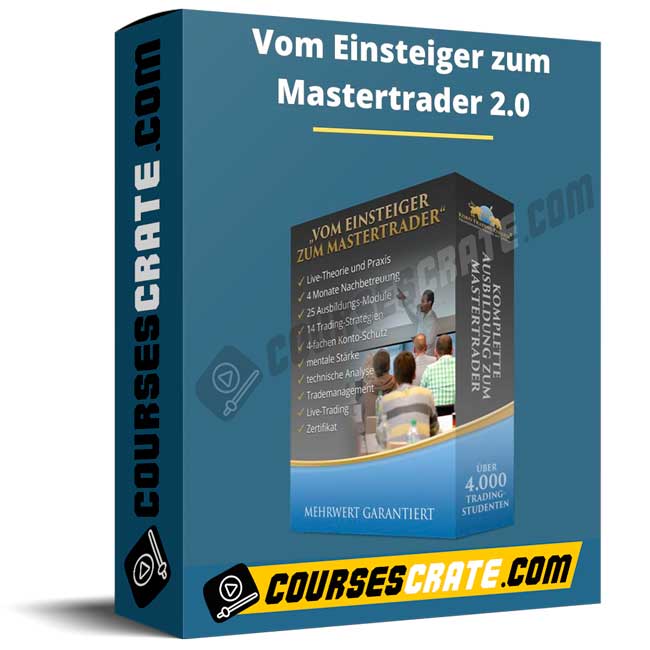
Vom Einsteiger zum Mastertrader 2.0
Original price was: $5,791.00.$318.00Current price is: $318.00.
Vom Einsteiger zum Mastertrader 2.0 is a structured trading training with 25 modules on mindset, risk, trade planning, trend and range strategies, and execution. Learn entries, exits, and rules you can practice step by step.
courses fast [ coursesfast.com ], giga courses [ gigacourses.com ], udcourse [ udcourse.com ], beast courses [ beastcourses.com ],
imarketing courses [ imarketing.courses ], digital assistant academy [ digitalassistant.academy ]
Permanent Access Links
Instant Access to HD Quality Courses
24/7 Expert Support
100% Safe & Secure Checkout
Courses Are Updated Regularly

Vom Einsteiger zum Mastertrader 2.0 is an online trading education program built to take you from the first clear foundations to a complete, rules-based workflow you can practice. The training is organized as a step-by-step curriculum, so you do not jump into advanced tactics before you understand risk, planning, and execution. If you want less guessing and more structure, this course is designed to help you think like a trader who measures decisions instead of chasing moves.
The program combines mindset, probability thinking, and concrete chart-based methods. You will work on how to prepare for the session, how to define a trade idea, how to protect capital when you are wrong, and how to secure profits when the market gives you an opportunity. Trading involves significant risk and this course is educational, but a structured process can improve decision quality and consistency.
What is the Vom Einsteiger zum Mastertrader 2.0 course about?
Vom Einsteiger zum Mastertrader 2.0 is positioned as a complete trading training with 25 modules that build on each other. The curriculum starts with learning mindset and the psychology of execution, then moves into probability and risk, profit protection, and a practical trading plan. From there, it expands into core market structure concepts and multiple strategies that relate to different conditions, such as trending markets, range-bound markets, gaps, momentum, and news-driven volatility.
A key feature of the program is the emphasis on structured learning. The training describes intermediate knowledge checks and a final assessment designed for self-evaluation, so you can identify gaps before they become costly mistakes in real trading. The offer also references a four-month period of follow-up support after completion, which is meant to help you stay on track while you implement the material.
What will you learn?
- How to frame trading with probability and risk, including how to break a trade into phases and define clear risk boundaries.
- How to protect profits with practical exit decisions, including when to use stop- and limit-based approaches.
- How to build a personal trading plan that covers routine, risk limits, and the rules you will follow before, during, and after trades.
- How to read trend conditions and execute foundational trend trades with clear entry, stop, and management rules.
- How to apply strategy concepts for different market behaviors, including opening setups, breakouts, trend-following, gaps, ranges, momentum, and news.
- How to use structure tools such as support and resistance, trend lines, and retracement entries to improve timing.
- How to recognize reversal patterns and correction patterns, and how to adapt when a trend changes direction.
- How to integrate advanced topics like Elliott waves and intraday trend-following into a larger plan.
- How to identify common trading no-go behaviors and build guardrails that protect your process.
- How to move from theory to practice with implementation guidance and a Q&A-style wrap-up module.
Who is it for?
This program is designed for beginners who want a clear path, and for intermediate traders who feel stuck because their approach is inconsistent. If you have watched random videos, collected indicators, and still do not have a repeatable routine, the step-by-step structure can help you consolidate your process.
It can also fit traders who want to improve discipline under pressure. Parts of the curriculum focus on mental phases, preparation, and the practical habits that influence execution quality. If you already trade but struggle with exits, late entries, or breaking your own rules, the risk and planning modules can be especially useful.
How does it work?
Vom Einsteiger zum Mastertrader 2.0 is delivered as an online training with a 25-module curriculum. The modules are designed to be taken in order, from the learning mindset and risk foundations to strategies and advanced pattern topics. Along the way, the training describes intermediate checks plus a final evaluation to help you measure what you absorbed, followed by a referenced post-program support period.
A practical way to use the course is to build a simple trading notebook. After each module, write down: your rule, your example, your invalidation point, and your review question. Then practice on historical charts and in a demo or small-risk environment before you scale up. The goal is not to collect ideas. The goal is to install a system and prove it to yourself with disciplined repetition.
Because markets can move fast, keep the implementation simple: define the setup, define the stop, define the exit logic, and define what you do if conditions change. If you want a clearer workflow, access the course now and start turning theory into a routine you can repeat.
Benefits
The main benefit is structure. Instead of reacting to price, you build a process that starts with preparation and ends with review. That can reduce emotional decision-making and help you focus on what you control: your entries, your risk limits, and your execution quality.
- Clearer decision-making through a step-by-step curriculum and defined rules.
- Stronger risk discipline built around probability thinking and trade phases.
- Better market adaptability by learning different approaches for trends, ranges, gaps, and high-momentum situations.
- Improved self-review habits supported by checkpoints and structured implementation.
Prerequisites
No formal prerequisites are required. You will benefit from basic chart familiarity and a trading platform where you can mark levels and review swings. Since this is trading education, a responsible mindset is essential: only risk what you can afford to lose, test ideas before scaling, and never treat education as a guarantee of results.
About the author or academic institution
The training is presented by Koko Trading College and is taught by Kroum (Koko) Petkov. The program is structured as a progression of modules from foundations to advanced topics, with an emphasis on risk awareness, execution discipline, and defined strategies.
To stay fully accurate, match your product page details to the official listing you are using (edition, included support period, and access conditions), since digital offers can be updated over time.
Why buy from our online course platform?
Centralize your digital purchases in a single account, keep your history, and access them whenever you want to watch online or download. Plus, you’ll always find courses on our platform at affordable prices.
Course content
- Module 1: Einstellung zum Lernen (Learning mindset)
- Module 2: Wahrscheinlichkeit und Risiko (Probability and risk)
- Module 3: Gewinne sichern (Securing profits)
- Module 4: Mentale Phasen und Zustände (Mental phases and states)
- Module 5: Warum Trader sein? (Your motivation)
- Module 6: Tradingplan (Trading plan)
- Module 7: Der Trend und der erste Trade (Trend basics and first trade)
- Module 8: Eröffnungsstrategie (Opening strategy)
- Module 9: Eröffnungsrange – Setup: Break-Out (Opening range breakout)
- Module 10: Trendfolgestrategie (Trend-following strategy)
- Module 11: GAP-Strategie (Gap strategy)
- Module 12: Rangestrategie und Feierabendstrategie (Range and evening strategy)
- Module 13: Momentumstrategie (Momentum strategy)
- Module 14: News-Strategie (News strategy)
- Module 15: Wiederholung der Grundlagen (Review of fundamentals)
- Module 16: Widerstand und Unterstützung (Support and resistance)
- Module 17: Trendlinien (Trend lines)
- Module 18: Ins Retracement einsteigen (Entering on retracements)
- Module 19: Trendumkehrformationen (Trend reversal formations)
- Module 20: Korrekturmuster (Correction patterns)
- Module 21: Elliottwellen (Elliott waves)
- Module 22: Tagestrendfolge (Intraday trend-following)
- Module 23: Antizyklischer Mut (Contrarian courage)
- Module 24: Freestyle und No Go’s (Freestyle rules and no-go behaviors)
- Module 25: Umsetzung und Fragen (Implementation and questions)
Access the course now and start building a trading routine that is structured, testable, and risk-aware.
Downloadable Course Content
Be the first to review “Vom Einsteiger zum Mastertrader 2.0”
You must be logged in to post a review.
Related products
Sale!
Forex & Trading
Original price was: $500.00.$44.00Current price is: $44.00.

Forex & Trading
$2.00
Sale!
Forex & Trading
Original price was: $247.00.$4.00Current price is: $4.00.
Sale!
Forex & Trading
Traders Reality – Scalp Trading Using The Hybrid System 2025
Original price was: $149.00.$19.00Current price is: $19.00.
Sale!

Forex & Trading
Original price was: $1,249.00.$123.00Current price is: $123.00.
Sale!
Forex & Trading
Original price was: $199.00.$21.00Current price is: $21.00.
Sale!
Forex & Trading
Original price was: $797.00.$74.00Current price is: $74.00.
Sale!

Forex & Trading
Original price was: $2,997.00.$32.00Current price is: $32.00.
Reviews
There are no reviews yet.